What is Blue Aura?
In aura traditions, blue aura meaning usually points to a calm, expressive energy field linked to the throat center. Practitioners read the color as a sign of clear speech, steady thinking, and a temperament that prefers honesty over performance. Most aura literature ties this hue to the throat chakra (Vishuddha), the energy area associated with communication, truth-seeking, and measured self-expression. Lighter shades tend to read as gentleness and emotional sensitivity, while deeper, indigo-leaning shades are commonly described as inner intuition and quiet spiritual maturity. None of this is a measurable physical fact; it is an interpretive convention inside subtle-energy frameworks that gives people a shared vocabulary for traits that show up around communication and self-expression.
Why It Matters for Self-Awareness
The reason blue aura meaning matters has very little to do with cosmic identity and a lot to do with how people make sense of their own communication style. Most pages search results return treat the topic as either pseudo-physics ("an electromagnetic field around the body") or a personality verdict ("you are a psychic healer"). Neither is helpful. The first overpromises a science that does not exist. The second hands readers a flattering label they have to either earn or reject.
A lens for self-recognition
A more honest reading is interpretive. If your aura is read as blue, it suggests the people around you experience you as someone who thinks before speaking, asks careful questions, and gets uncomfortable when conversations turn vague or dramatic. That maps to a real lifestyle question: do you actually want roles, friendships, and workdays that reward clarity and measured language? If yes, the framework points you toward situations where your default style is an asset. If you are a quiet introvert who feels like an imposter when articles call you a "psychic communicator," the framework is the problem, not you. Treat blue aura meaning as a lens for self-recognition, not a diploma.
A few concrete examples of where this reading actually changes behavior. A project manager who is told her aura is blue may stop apologising for asking three clarifying questions before agreeing to a deadline; the trait she was treating as friction is what makes her estimates accurate. A teacher who finds out his hue reads blue may stop trying to imitate the loud, charismatic colleague down the hall and instead lean harder into the quiet, structured explanations his students actually remember. A founder may realise the reason her cold emails work is not magic but the slow, plain-language paragraphs she keeps trying to "warm up." In each case the reading is doing low-stakes self-recognition work — naming a pattern the person was half-aware of and giving them permission to stop fighting it. That is the practical value most over-claimed articles miss, because they are too busy promising psychic gifts to talk about ordinary workdays.
When the description doesn't fit
There is also a useful counter-use. If the description does not fit you — if your friends would laugh at the idea that you are calm or articulate — the reading is still informative, because it tells you which traits you may be unintentionally signalling versus actually living. Auras as a framework are observer-influenced; what someone "reads" is partly about how you come across, not only how you feel inside. Noticing the gap between the two is more useful than memorising what each color is supposed to mean.
How Common Is Belief in Subtle Energy?
It helps to know that the worldview blue aura meaning lives inside is far from fringe. In a 2023 Pew Research Center survey of U.S. adults, 65% said they believe in "spirits or unseen spiritual forces," 48% said parts of nature like mountains, rivers, or trees can have "spirits or spiritual energies," and about 26% said objects such as crystals, jewels, or stones can have spiritual energies (Pew Research Center). Read those as figures for how many people hold the worldview that aura reading lives inside — not as evidence the aura is physically real. On that second point the record is clear: when the ability to see auras has been tested under controlled scientific conditions, it has not been shown to exist (Wikipedia). So blue aura meaning is best read as an interpretive vocabulary, not a measured property.
Blue Aura vs Adjacent Concepts: Mechanism + Trade-offs
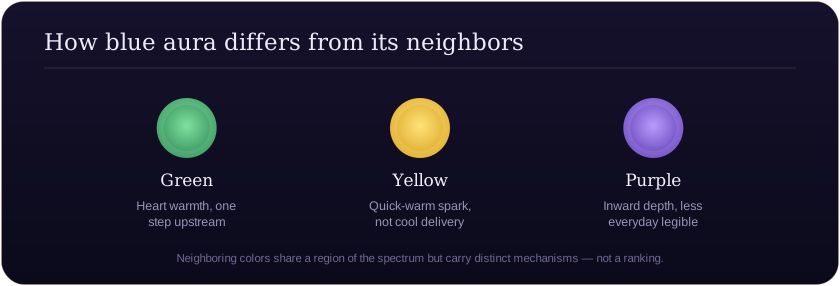
Blue aura meaning differs from neighboring color readings because the mechanism is centered on how you express what you already feel, not on how you generate or receive feeling in the first place. Green aura readings, for example, are commonly described as heart-centered: warmth, care, and emotional attunement to others. The blue reading is one step downstream, in the throat area, where feeling becomes language. To get the precision blue aura meaning emphasises, you sacrifice some of green's instinctive warmth; people may experience your responses as thoughtful but slightly cool.
Versus yellow, violet, and indigo
Compared with yellow aura, the trade-off shifts again. Yellow is usually framed as bright, outward, and quick to engage; blue is slower and more deliberate. Choosing throat-led communication over yellow's solar-plexus energy gets you steadier delivery, but you lose some of the spark and improvisational charm. Compared with violet or indigo aura, the difference is depth versus accessibility: light blue tends to be more relatable and conversational, while indigo is read as introspective and harder to access from the outside. To get violet's depth, you sacrifice everyday legibility; to keep light blue's clarity, you sacrifice some mystique. None of these are rankings. They are stylistic trade-offs people use the colors to name.
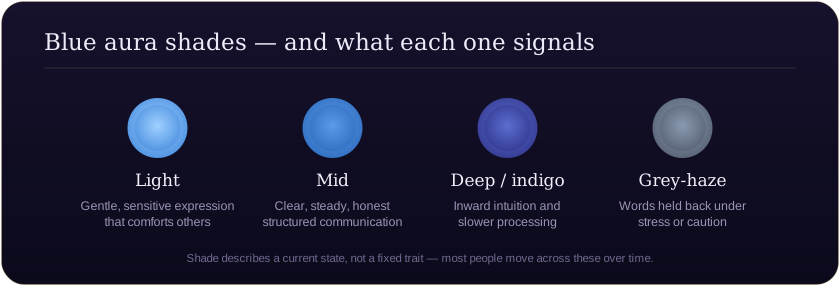
Inside the blue family itself, light blue is commonly read as gentle, sensitive, and comforting, while deep blue is described as inwardly focused and protective of its convictions. Light blue gives you approachability at the cost of some authority; deep blue gives you gravity at the cost of warmth. Most aura literature distinguishes these shades as different points on a single axis: clarity that reaches outward versus clarity that turns inward.
Shade scenarios in practice
A few practical scenarios make the shade differences concrete. A light blue reading often shows up in people who are good at one-on-one consoling — a friend you call after a bad day, a nurse with bedside manner, a customer-success lead who can de-escalate angry users without flattery. A mid blue reading is more often associated with the role of trusted explainer — someone who can hold a complicated topic in plain words and not over-perform expertise. Deep or indigo blue is typically read as the editor, researcher, or long-form thinker; the person who would rather spend three days writing one careful paragraph than ten quick takes. None of these are predictions. They are styles people use the colors to name, and most readers will recognise one as their default mode and another as a mode they reach for under pressure.
Two common confusions are worth flagging. First, people sometimes see "different blue auras in different photos" — light blue in one, indigo in another — and worry they are imagining the shift. Most practitioners treat color shifts as situational: the same person can read lighter in a relaxed conversation and darker in a moment of inward focus. The trait is the temperament under both shades, not a fixed pigment. Second, this color is sometimes confused with sadness, because "feeling blue" is a phrase about low mood. In aura framing the meaning is different: the hue is about a communicative posture, not an emotional state. A cheerful person and a quiet, reflective person can both register as blue if their default mode is clear, considered expression.
Blue versus red
One more practical contrast: blue versus red. Red aura readings are typically tied to the root area and described as physical, action-driven, and quick to assert. To get red's drive and immediacy, you sacrifice some of the throat reading's patience and editorial restraint. People often have one as a default and the other as a back-up gear they reach for under pressure. Knowing which is which is useful when you are choosing a job, a co-founder, or how to plan a hard conversation. The point of the comparisons is not to rank colors but to give you language for trade-offs you are already making by temperament.
How to Read Blue Aura in Yourself
Blue aura tends to manifest as a communication or perceptual signal before becoming a visual one.
Three self-check indicators:
- Communication as core need: Do you feel visibly drained when you cannot express yourself authentically?
- Intuitive listening: Do you often sense what someone means before they finish speaking?
- Sensitivity to dishonesty: Does a conversation that lacks authenticity feel physically uncomfortable?
If these patterns are consistent, blue is likely an active frequency in your current field.
Common Misreadings
Misread 1: All blue auras mean the same thing This is the root cause of conflicting search results. "Blue aura" covers a wide spectrum — light blue signals gentle, receptive communication; dark blue indicates deep introspection and internal processing; indigo is a distinct adjacent frequency with stronger psychic overtones.
Misread 2: Blue and indigo are interchangeable They are related but structurally different. Blue governs the throat center (communication, expression). Indigo governs the third eye center (perception, vision). A reader calling blue "indigo" is reading a different layer of the same signal.
Misread 3: Blue means calm, always Blue can manifest as emotional depth that looks like calm from the outside but is internally highly active. What reads as "calm" may be sustained internal processing.
Quick Reference Table
| Property | Mechanism | Energy Center | Common Misread |
|---|---|---|---|
| Light blue | Gentle, sensitive expression that comforts others and prefers low-conflict tone | Throat center (Vishuddha) | Read as passivity instead of considered restraint |
| Mid blue | Clear, steady communication and a preference for honest, structured conversation | Throat center (Vishuddha) | Read as cool or emotionally distant when actually composed |
| Deep / indigo blue | Inward intuition, slower processing, protective of inner convictions | Throat area extending toward the brow | Read as aloof or "psychic" rather than introspective |
| Blue with grey haze | Communication style under stress; words held back or filtered | Throat center, restricted flow | Read as dishonesty instead of fatigue or caution |
Where the Blue Reading Comes From: A Short Cultural History
Knowing the lineage helps you treat blue aura meaning as an inherited symbolic language rather than a literal scan, and three threads run through it. First, the throat-chakra link the reading leans on is traceable: in the Hindu yogic traditions of tantra the throat center is Vishuddha, whose Sanskrit name means "very pure," which is associated with creativity, self-expression, and the action of speaking and with the element akasha (ether), and whose symbol includes a sky-blue downward-pointing triangle (Wikipedia). Second, the idea of a colored energy field around a person is comparatively modern: it was popularized by Theosophical Society member Charles Webster Leadbeater, who illustrated colored auras in Man Visible and Invisible (1903) and incorporated the chakra system into the aura model in The Inner Life (1910) (Wikipedia). Third, the deeper root is older still: prana, the body's vital "airs" or energies, was a central conception in early Hindu philosophy as expressed in the Upanishads (Encyclopaedia Britannica); and visually, the convention of depicting holiness as light around a figure long predates aura photography in the halo or nimbus of religious art, where the sun-god Helios and Roman emperors appeared with a crown of rays before Christ was shown with a circular nimbus from the middle of the 4th century and the Virgin Mary and other saints by the 6th (Encyclopaedia Britannica).
Reflection Prompts
- Think of a recent moment when you stayed quiet to choose words carefully — was that clarity, or avoidance dressed up as calm in your blue aura meaning?
- Recall the last conversation where you felt fully understood; what did you do differently with your voice, pace, or word choice?
- Notice when you last softened a hard truth for someone — did the softening serve them, or protect you from their reaction?
Common Questions About Blue Aura
Q: Why do different sources say different things about blue aura meaning? A: Blue aura spans multiple shades with distinct interpretations. Light blue, dark blue, and indigo are often grouped together but carry different signals. Additionally, different traditions (Theosophical, New Age, chakra-based) use different frameworks. This guide uses the chakra-based structural approach, anchored to the throat center.
Q: What's the difference between a light blue and dark blue aura? A: Light blue indicates openness, receptive communication, and emotional gentleness. Dark blue signals introspection, strong internal processing, and a preference for depth over surface.
Q: Is blue aura the same as indigo? A: No. Blue corresponds to the Throat Chakra — the center of expression and communication. Indigo corresponds to the Third Eye Chakra — the center of perception and psychic awareness. They sit in adjacent frequencies but govern distinct functions.
Q: What does a blue aura say about someone's communication style? A: Blue aura individuals tend to be careful, authentic communicators who are more comfortable with meaningful exchange than small talk. They often have high sensitivity to dishonesty in conversation.
Q: Can someone with a blue aura also have other colors? A: Yes. Blue combined with green often indicates an empathic healer-communicator. Blue with purple suggests heightened intuitive perception layered over strong expressive drive.
Sources
- Brennan, B. A. (1988). Hands of Light. Bantam Books.
- Andrews, T. (1991). How to See and Read the Aura. Llewellyn Publications.
- Judith, A. (2004). Eastern Body, Western Mind. Celestial Arts.
Related Reading
- pillar page on all aura colors overview — start here for a side-by-side view of how each color is interpreted across traditions.
- throat chakra explainer — the energy center most often paired with this color in aura readings.
- comparison with purple aura — useful when your reading shifts between blue and violet shades.
- guide to yellow aura traits — a contrasting solar-plexus reading that highlights what blue is not.
- white aura explainer — the high-frequency, integrative color, a useful contrast to blue's throat-led clarity.
- green aura explainer — the heart-chakra reading one step upstream from blue, where feeling becomes language.
Take Action
Explore the aura colors guide to see how your colors map and combine.