
What is Green Aura?
Green Aura is the green band that practitioners describe seeing or sensing in a person's energy field. In most aura traditions, green aura meaning points to a heart-centred energy oriented toward care, balance, and healing.
- Leads with connection and emotional repair rather than ego or raw drive
- Most often tied to the heart center, called Anahata, in chakra-aura systems
- Shifts in tone by shade, so the same green can read as growth or as resentment
Green sits in the middle of the classic aura spectrum, between the warmer reds and oranges and the cooler blues, which is part of why it gets framed as the balancing point of the whole map. It belongs to the broader picture laid out in the pillar page on all aura colors, where every color's energy sits side by side — a way of reading the human energy field that teachers like Barbara Ann Brennan helped bring into wider practice. Green is less about intensity and more about how naturally someone moves toward repair, nature, and the people around them.
Why It Matters for Self-Awareness
Understanding green aura meaning matters because the write-ups online pull readers in two opposite directions, and most people can't tell which one actually fits them. In my years reading aura color, the green clients who show up most unsettled are usually the ones who've been handed two contradictory labels and asked to pick a side. The confusion tends to land in a few predictable ways:
- The healer-or-jealous split. One source calls green a natural-healer gift; another insists it means envy and bitterness. Same color, opposite verdicts, and no obvious way to reconcile them — so people leave more confused than they arrived.
- The shade blur. Emerald, forest, and that yellowish "muddy" green often get lumped into a single paragraph. Readers finish the article still unsure which shade describes them, which is the one question they came to answer.
- The healer-identity pressure. Article after article frames a green aura as a calling to become a therapist or energy worker. That feels wrong to a graphic designer who is doing perfectly fine, and it quietly implies they're wasting a gift by not switching careers.
That last point matters most, because a label that doesn't match your real life sets you up to feel like you're failing at a job you never applied for. A few green readers actually burn out chasing a "healer" identity that was never theirs to carry, pouring energy into everyone around them until there's nothing left for their own week. A reading earns its keep when it describes a leaning you can work with, not when it hands you a title you have to live up to.
Green Aura vs Adjacent Concepts: How It Works + Trade-offs
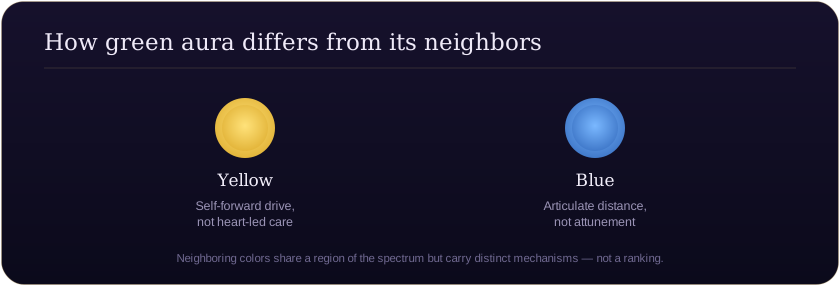
green aura meaning becomes clearer when you set it next to its neighbours on the spectrum, because the difference is mostly about where the energy is centred and what it asks of you. Green works through the heart center, so it pulls attention outward toward connection, repair, and balance — it's the person who senses a room has gone tense and quietly moves to smooth it. A nearby color like yellow aura works differently, running through the solar plexus and leading with confidence and personal drive. You can see that contrast in the sibling entry on yellow aura. To lead with green's heart-led warmth, you give up some of yellow's self-forward momentum: the green reader tends to others first and themselves last, which steadies the group and slowly drains the individual.
Against blue aura
Green also reads differently from blue aura, which is throat-centred and leads with clear, measured expression. Choosing green's emotional attunement over blue's articulate distance gets you closeness, but you lose some of blue's clean boundary, and the comparison with blue aura lays out how the two diverge. In practice that looks like a green reader who absorbs a friend's bad mood instead of naming it, where a blue one would have said the hard thing and moved on. The trade-off stays consistent: to be the person others lean on, you tend to take in more than you put out, and that often surfaces as quiet fatigue rather than open conflict.
Clear green vs muddy green
The sharpest contrast, though, sits inside green itself, between its clear and muddy shades. A vibrant or emerald green works by directing care toward genuine repair, while a muddy, yellow-green shows what happens when that same caring energy curdles into comparison and keeping score. The difference isn't really a new color so much as the same orientation under strain — the cost of caring deeply is that, left unprocessed, it can tip into resentment. Reading the shade honestly tells you whether your green is feeding you or quietly running you down. None of this is fixed; it describes how the energy tends to function, not a rule about who you have to be.
How to Read Green Aura in Yourself
Reading green aura meaning in yourself is less about staring at a photo and more about noticing recurring patterns in how you spend and recover your energy day to day. A few honest signals worth watching for:
- People bring you their problems first, and you move to fix or soothe before checking your own state.
- You recharge near plants, parks, or water, and feel scraped raw after too long in tense rooms.
- You measure a good week by how connected you felt, not by what you achieved or won.
- A faint envy surfaces when others rest guilt-free — a sign green may have slipped toward comparison.
- Conflict makes you go quiet and accommodating rather than loud, usually at your own expense.
These line up with the heart-centred reading explained in the chakra system overview, where green maps to Anahata — the framework Anodea Judith helped systematize for modern readers. No single signal confirms anything on its own; it's a cluster of them, showing up week after week, that most green readers recognise in themselves. If only one or two ring true, green may simply be one color among several you're balancing rather than your dominant one.
Common Misreadings
Most of the trouble around green aura meaning comes from a handful of misreadings that get repeated online until they sound like settled fact. Here is where the popular write-ups go wrong, and what's closer to the truth:
- "Green means you're a natural healer." Green leans toward care and repair, but that's an orientation, not a calling or a clinical role. Plenty of green readers are designers, engineers, and accountants who simply tend their relationships well and never go near a healing profession.
- "Muddy green means you're jealous and bitter." A yellowish, murky green is usually read as unprocessed comparison or resentment passing through. It points to a temporary state you can work with, not a permanent verdict stamped on your character.
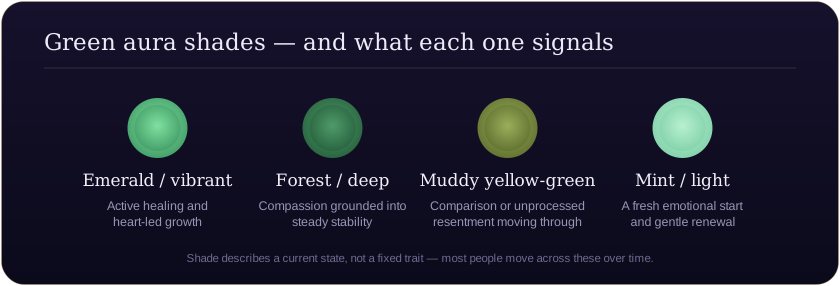
- "All shades of green mean the same thing." Emerald, forest, and mint carry distinct tones, and flattening them into one blurs the exact distinction most readers came to sort out. The shade is where the real information lives.
- "Green means you should always self-sacrifice." The heart-led reading describes a tendency to give; it is not an instruction to keep giving until you are empty. Healthy green includes knowing when to stop.
Green Aura at a Glance
| Property | How It Works | Energy Center | How to Observe |
|---|---|---|---|
| Emerald / vibrant green | Leads with active healing capacity and heart-led growth | Heart center (Anahata) | You feel energised after helping someone reconnect or recover |
| Forest / deep green | Grounds compassion into steady, dependable stability | Heart center, rooted toward the body | You stay calm and present while others are in crisis |
| Muddy / yellow-green | Signals comparison or unprocessed resentment moving through | Heart center under strain | You catch envy or score-keeping creeping into close ties |
| Mint / light green | Opens a fresh emotional start and gentle renewal | Heart center, newly active | You feel cautiously hopeful after a stretch of repair |
Common Questions About Green Aura
What does a green aura mean spiritually?
In most subtle-energy traditions, green aura meaning points to a heart-centred energy built around care, balance, and connection. It is read as an orientation toward repair and relationship rather than a fixed spiritual rank.
Does a green aura mean I'm jealous?
Not on its own. A clear or vibrant green is tied to healing and growth, and only a muddy, yellowish green is read as comparison or resentment moving through — even then, as a passing state.
Do emerald and forest green auras mean different things?
Yes. Emerald or vibrant green leans toward active healing and heart-led growth, while forest or deep green reads as grounded, steady compassion that holds up under pressure.
Can a green aura change over time?
Most aura literature treats color as a snapshot of your prevailing state, not a permanent label. The same person can read green through a season of caretaking and shift as their focus moves on.
Reflection Prompts
- Think of a recent moment when you fixed someone else's problem before tending to your own — what did that cost you?
- Recall the last time nature or a quiet space restored you; what were you carrying before you arrived?
- Notice a recent week you felt genuinely connected — what made that closeness possible, and who made room for it?
Related Reading
- red aura explainer — the root-chakra contrast to green's heart-centered balance.
- orange aura explainer — the sacral creative-social energy, one center below the heart.
- Chakra (Wikipedia) — background on the energy centres behind the color
Take Action
Explore the aura colors guide to see how your colors map and combine. As you read through how you spend and restore your energy, you get a plain-language sense of which colors are loudest for you right now — including whether green is leading with healthy care or tipping into the overgiving the labels keep warning about. Seeing that on the page is what turns a vague color label into a small, usable check-in you can do for yourself the next time you can't tell whether you're caring or quietly running on empty.
Sources
- Judith, A. (1999). Wheels of Life. Llewellyn Publications.
- Brennan, B. A. (1988). Hands of Light. Bantam Books.