What is Purple Aura?
In subtle-energy traditions, purple aura meaning usually points to an introspective, intuition-leaning energy field tied to the crown and third eye centers. The reading is interpretive, not measurable: practitioners describe purple as the visual shorthand for someone whose attention naturally drifts inward, toward pattern, symbol, and meaning, instead of outward toward action or social negotiation. Most aura literature places this hue at the top of the spectrum, where it overlaps with violet and indigo, which is why the three names get used interchangeably even though many readers separate them by shade. Perceiving a purple haze around a person is a subjective practice, closer to interpretation than detection, and it does not require any claim about electromagnetic fields, psychic certification, or a special soul rank.
Why It Matters for Self-Awareness
Most people who search purple aura meaning are not trying to prove they have a gift. They are trying to settle three quieter worries. The first is the shade problem: one site uses "violet" for the same trait another site files under "indigo," and a third blurs both into "purple," so the reader cannot tell whether their inner sense of the color matches anyone else's vocabulary. The second is the self-doubt loop: the person notices something that looks like a soft lavender haze around a friend, then immediately wonders whether they are seeing it, remembering it from an article they read last week, or constructing it on the spot. The third, and the heaviest, is the overclaim problem. Too many articles equate this color with "psychic mastery," "old soul," or "crystal child," and the actual reader feels tired, distracted, and unspecial in comparison, not enlightened.
A grounded reframe, by shade
A grounded version of the framework relieves all three. It says: shade names vary by lineage, so you are not failing at the vocabulary. It says: perceiving aura is an interpretive habit, not a clinical test, so noticing a tint and feeling unsure about it is the normal state, not a sign of delusion. It says: the color points to an orientation, an inward, meaning-seeking tilt, not to a rank in some spiritual hierarchy. That reframe matters for self-awareness because it returns agency to the reader. You stop asking "am I high-frequency enough" and start asking "how does my attention actually move during the day, and where does that help or hurt me."
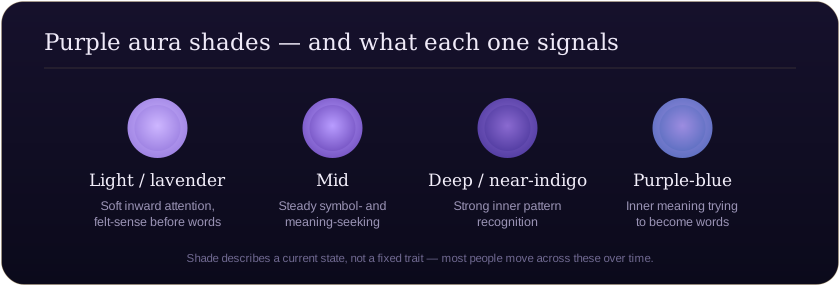
A second self-awareness payoff sits inside the shade question. Lighter purples, sometimes filed as violet, are commonly described as more empathic, more porous to other people's moods, more outwardly tuned even when quiet. Deeper purples, sometimes folded toward indigo, are described as more interior, more pattern-focused, more at risk of disconnecting from the small concrete tasks of a day. Recognizing that the same person can shift across these shades across seasons is what stops the framework from hardening into a verdict. A consultant in heavy synthesis weeks may read as deep purple; the same consultant on holiday with friends may read as lighter, more permeable lavender, and neither reading is more "true" than the other.
Purple under stress
A third payoff is the use under stress. Purple-leaning attention under pressure tends to drift in predictable ways. Slow integration becomes paralysis. Pattern recognition becomes overthinking. Meaning-making becomes a polite way to avoid the boring concrete task the day actually requires. None of those drift states proves the framework misidentified you. They just show that the same instrument that helps you notice context can also keep you stuck inside it. A practical use of purple aura meaning is to run one weekly check: did this week's inward processing produce any outward step at all, even a small one? A week of pure synthesis with zero action is usually a signal that you are sitting on a perception you have not been willing to surface, not evidence that the world is too coarse for you.
The framework hurts when it gets turned into a hierarchy. The moment a reader starts ranking purple above yellow or red because purple sounds more "spiritual," the same reframe that returned agency in the first paragraph starts taking it away again. Treating this color as an orientation makes the question productive; treating it as a tier makes the question performative.
Purple Aura vs Adjacent Concepts: Mechanism + Trade-offs
The most useful contrasts for purple aura meaning are with violet, indigo, blue, and white, because these are the colors most often confused with it.
Versus violet and indigo
Violet, in many traditions, is treated as a lighter, more outward-pointing cousin. The mechanism is similar to purple's, crown-leaning attention, but violet is read as more porous, more empath-flavored, more available to other people's feelings in real time. To get the empathic openness of violet, you sacrifice some of purple's quieter, self-referential pattern-finding; to get the inward pattern-finding of darker purple, you sacrifice some of the warmth and social attunement violet allows.
Indigo overlaps even more, and the names are often swapped. The cleanest separation: indigo is usually framed as third-eye dominant, more about perception and recognition of unspoken structure, while purple sits closer to crown, more about orientation toward meaning and the symbolic. To get indigo's sharp pattern recognition, you sacrifice some of purple's openness to ambiguity and undefined experience; to get purple's tolerance for things that are not yet shaped, you sacrifice some of indigo's diagnostic edge.
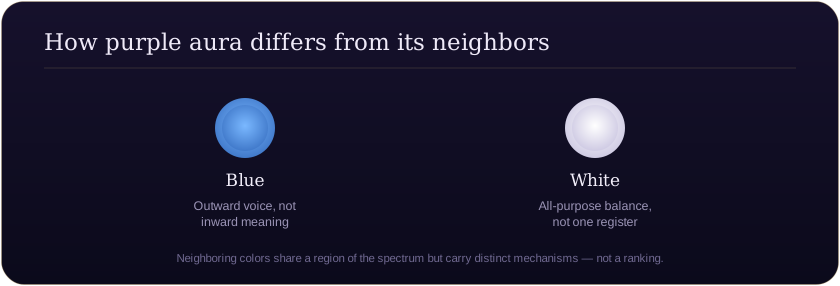
Versus blue and white
Blue aura sits one band lower and reads as throat-led, communicative, articulate. The contrast with purple aura meaning is sharp here. Choosing inward, meaning-led attention over outward, communicative clarity gets you depth, but you lose some legibility, others may not know what you are processing because you are not narrating it. Conversely, to get blue's clarity of voice, you sacrifice some of purple's tolerance for the unfinished thought and the half-formed sense.
White aura, often framed as integrative, pulls in the opposite direction from purple's specificity. To get white's smooth, all-things-balanced quality, you sacrifice purple's willingness to dwell in one symbolic register; to get purple's depth in one register, you sacrifice the broad evenness white is associated with.
The shared trade-off
Across all four comparisons, the through-line is the same trade-off: this color rewards the reader who wants to stay with meaning, pattern, and the symbolic, and the cost is being less available for fast social translation, quick verbal articulation, or smooth all-purpose balance. The framework helps when it points you toward your real default; it hurts when it locks you into that default and tells you the rest of the spectrum is beneath you.
Why traditions disagree
A practical caveat applies to every one of these contrasts. Aura color systems are not consistent across traditions. One school swaps violet and purple in adjacent positions. Another collapses indigo into purple entirely. A third treats shade gradient as more informative than category at all, and reads color movement across a single conversation as the actual signal. When you encounter a description that does not match your own sense of the color, the move is not to declare the source wrong; it is to ask which lineage is being used and whether its assignment matches the question you walked in with. Two readers can both be right about a single person and still pick different names, because they are running different conventions, not measuring different objects.
One last note on the "am I imagining it" question that drives much of the search traffic. The traditions themselves do not require you to literally see color to use the framework. Many readers use the vocabulary based on temperament: they read a description, recognize themselves, and start using the label as a way of naming a tendency they had not previously had a word for. That is a legitimate use of the purple aura meaning even if you have never seen a colored field around anyone, including yourself. The framework rewards attention to inner pattern, not certainty about visual perception, and the readers who get the most value from it tend to be the ones who treat the color name as a working description of their own attention rather than a perceptual claim they need to defend to a skeptic or prove to themselves on a bad day.
How to Read Purple Aura in Yourself
Purple aura tends to manifest as a perceptual or relational signal before becoming visual.
Three self-check indicators:
- Pattern sensitivity: Do you notice symbolic or thematic connections others miss?
- Energetic boundary awareness: Do you absorb the emotional states of people around you
without choosing to?
- Internal orientation: Is your default processing mode inward — through reflection and
meaning-making — rather than outward action?
If two or more apply consistently, purple is likely an active frequency in your current field.
Common Misreadings
Misread 1: Purple always means psychic ability Purple is commonly conflated with psychic gifts, but it more accurately describes a perceptual orientation — the tendency to process experience through meaning and pattern. Active psychic development may produce purple, but purple does not require it.
Misread 2: Purple and indigo are the same Indigo sits at a more focused frequency — it maps to the third eye center and emphasizes vision and perception. Purple spans the upper two centers (third eye and crown) and includes both perceptual and transcendent qualities.
Misread 3: Purple aura means spiritual advancement Aura readings describe current energetic state, not hierarchy. A purple reading reflects a current orientation — not a rank, achievement, or fixed identity.
Quick Reference Table
| Property | Mechanism | Energy Center | Common Misread |
|---|---|---|---|
| Light purple / lavender | Soft inward attention, openness to felt-sense before words | Crown-leaning, with some third eye | Read as "psychic gift" when it is actually quiet interpretive openness |
| Mid purple | Steady symbol- and meaning-seeking orientation | Crown and third eye blend | Read as "old soul" rank when it is just an attentional tilt |
| Deep purple / near-indigo | Strong inner pattern recognition, drawn to structure beneath surface | Third eye-dominant, crown nearby | Read as detached when the person is simply running an inner thread |
| Purple flickering with blue | Inner meaning-making trying to translate into words | Crown plus throat | Read as scattered when the person is mid-articulation |
Reflection Prompts
- Think of a recent moment when a conversation felt meaningful, what specifically drew your attention inward rather than to the speaker's words?
- Recall the last time you noticed a pattern across unrelated situations, did you share it with anyone or keep it private, and why?
- Notice when you most recently felt out of step with a group, was the purple aura meaning of inward, symbolic attention pointing somewhere the room was not tracking?
Common Questions About Purple Aura
Q: Is purple aura the same as indigo or violet? A: They are related but distinct. Purple sits between blue and red and signals spiritual awareness combined with grounded energy. Indigo is deeper and more psychic-focused. Violet leans toward transcendence and transformation.
Q: Is a purple aura rare? A: There is no reliable way to rank aura colors by rarity. Within this framework, purple is often associated with a strong intuitive orientation or an active spiritual practice — a description of current focus, not a fixed trait.
Q: What does a dark purple aura mean vs. light purple? A: Light purple suggests emerging spiritual gifts and openness. Dark purple is often read as deeper inward attunement in some traditions, rather than a marker of status or ability.
Q: Can someone have both purple and another color in their aura? A: Yes. Aura combinations are common. Purple combined with blue often indicates a highly intuitive communicator; purple with white suggests spiritual purification.
Sources
- Andrews, T. (1991). How to See and Read the Aura. Llewellyn Publications.
- Brennan, B. A. (1988). Hands of Light. Bantam Books.
Related Reading
- pillar page on all aura colors — the overview that places this color in the full spectrum and clarifies how shades relate.
- Violet aura — close cousin that often gets blurred with purple; the empath-versus-introspective split is what separates them.
- Indigo aura — the third-eye-dominant neighbor that shares much of the same territory but reads as more pattern-sharp.
- blue aura explainer — the throat-led contrast, useful when you want to feel the trade-off between expression and interiority.
- white aura explainer — the integrative neighbor, useful for understanding why purple feels narrower in register.
- crown chakra explainer — the center most often paired with purple in mainstream aura teaching.
- red aura explainer — the root-chakra contrast, useful for feeling the pull between grounded action and inward meaning.
- green aura explainer — the heart-chakra healing energy that contrasts with purple's upper-center orientation.
Take Action
Explore the aura colors guide to see how your colors map and combine.