
What is White Aura?
In subtle-energy traditions, white aura meaning usually points to a clear, integrative energy field tied to the crown center and spiritual orientation. It is most often linked to the crown chakra (Sahasrara), and some lineages treat it as an "all-color" or integrative state rather than a single archetype on a ladder. Bright, clean white is read as presence and clarity, while muddier shades carry different signals. The label is interpretive vocabulary used for self-reflection, not a clinical or moral grade, and aura is not a measurable electromagnetic phenomenon. It is a convention practitioners use to describe how someone seems to carry themselves on a given day, and the reading is meant to change with sleep, stress, and inner attention rather than stamp a person with a fixed identity.
In practice, the word people reach for when they sense this quality is rarely "white" at first. They tend to say someone seems unusually clear, or hard to read, or oddly spacious — present in the room without pushing anything. A teacher who has just finished a long term, a nurse coming off a stretch of night shifts and into a quiet week, a person two months past a hard goodbye: these are the everyday situations where the description tends to land, less because the person has arrived somewhere and more because they have set something down. The shade matters as much as the colour name. A clean, bright version reads one way; a flat, washed-out grey-white reads another; a cool silver-white reads a third. Collapsing all three into one word is what makes the whole vocabulary feel vague, and keeping them apart is what lets it describe a specific week rather than a vague mood.
Why It Matters for Self-Awareness
The reason white aura meaning matters is that the label sits very close to a trap. Most popular articles tell readers that white means pure, chosen, or spiritually evolved, which sounds flattering until you realise you are simply a tired person with bad sleep, not an enlightened being. When the description inflates self-image, it stops being a mirror and becomes a costume.
A mirror that tracks your week
A useful read does the opposite work. It helps you notice when your presence feels open and uncluttered, when your attention feels scattered, and when your kindness has tipped into over-giving. The same reader who feels "bright white" after a quiet morning may feel "grey-white" after three days of saying yes to everything. The label is only useful if it tracks those shifts honestly. Consider a parent who has been on call for two weeks of school holidays; if the white aura description still calls them serene and elevated, the vocabulary has stopped describing reality and started flattering a tired person.
Ranking anxiety and shade confusion
The other common snag is ranking anxiety. Some sources frame white as the top of a colour hierarchy and red as the bottom, which turns a self-reflection tool into a competition. Aura colours in mainstream practice are not levels on a leaderboard. They are different languages for different states, and a person whose dominant colour shifts across a week is not "downgrading," just moving through life. Treating red as inferior to white also misreads red, which is usually described as vitality and groundedness rather than coarseness.
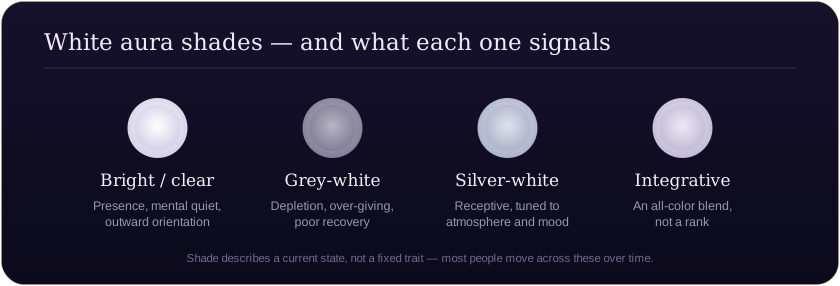
Shade confusion is the third real pain point. Bright white, grey-white, and silver-white are often described as if they were the same thing, but practitioners typically read them as quite different signals. Treating them as interchangeable is what makes the whole vocabulary feel arbitrary. Once the shades are separated, the language starts to do real work, and a "white" reading stops being a single flag and becomes three useful ones: bright as steady presence, grey as a call to rest, silver as a hint that you are picking up the room more than usual.
Guarding against over-identification
A fourth use of the label is as a check on spiritual over-identification. If "having a white aura" becomes a stable identity claim, it tends to lock the reader into performing serenity even when life is messy. Used well, the label is the opposite of an identity; it is a weather report. A person who has had three nights of broken sleep, taken on a sick parent's appointments, and skipped meals is not less "white" because they are short-tempered that afternoon; they are reading honestly that the crown-area sense of spaciousness has narrowed under load. The reading is information about the week, not a verdict on the soul.
It also helps to notice where the label is misused socially. White-aura language is sometimes deployed in spiritual communities to mark some members as more advanced, which quietly recreates the ranking problem in social form. A reader can keep the vocabulary useful by refusing to treat it as a credential and instead asking whether the description matches what they actually felt during the day.
White Aura vs Adjacent Concepts: Mechanism + Trade-offs
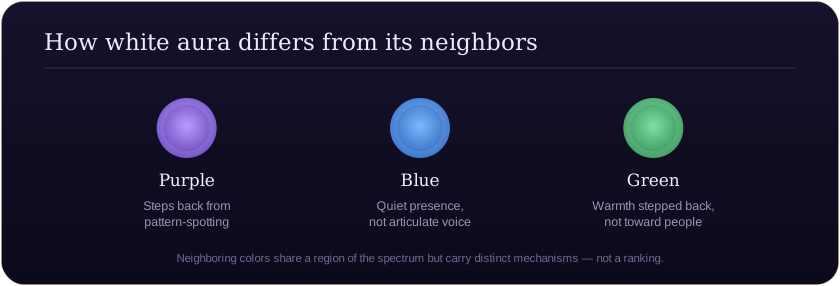
White aura meaning differs from purple aura because the two describe different stances rather than different ranks. Purple is commonly tied to the third-eye area and reads as intuitive pattern-spotting, looking for symbolic meaning behind events. White, anchored more in the crown area, reads as a step back from the patterns themselves. To get the open, "above the fray" quality of white, you sacrifice some of the sharp interpretive bite of purple. To keep purple's symbolic precision, you trade away some of white's spaciousness. A person leaning purple may sense what a dream "means"; a person leaning white may simply rest in not needing to know yet.
Against blue aura
Against blue aura, the contrast lands in a different place. Blue, tied to the throat centre, is about clarity of voice and considered expression. White is less about saying the thing well and more about a quiet, settled presence underneath the talking. Choosing white-leaning stillness over blue-leaning articulation gets you composure, but you lose some of the crispness blue brings to a conversation. Two colleagues running the same meeting can look very different: the blue-leaning one structures the discussion sharply, the white-leaning one steadies the room without saying much. Neither is correct; the trade-off is real.
Across the three white shades
The most useful comparison, though, is across the three white shades themselves. Bright, clear white is read as presence, mental quiet, and an outward spiritual orientation. Grey-white or muddy white is read as depletion, over-giving, or a long run of poor recovery, not a clinical diagnosis. Silver-white is read as receptive and mystically tuned, more sensitive to atmosphere than to action. The trade-off here is honest: to keep bright-white clarity, you sacrifice the soft openness of silver-white, because true receptivity often means you also pick up the noise of a room. To stay silver-white receptive, you give up some of the firmness that bright white carries into decisions.
The "highest colour" and "chosen one" framings
White aura meaning is also frequently confused with the idea of being "the highest" colour. In the lineages that actually treat white as integrative, it is not above the other colours; it is simply a different framing in which several colours blend. A person who reads as white this month and yellow next month has not lost rank; they have moved from a more integrative stance into a more outwardly warm one.
A final useful contrast is against the popular "chosen one" frame. To accept that you carry a white aura in any moment, you have to give up the story that this makes you special. The cost of holding the label honestly is the comfort of feeling unique; the reward is a description that actually tracks your week. The same person can read as bright white on Tuesday after a long walk and grey-white on Friday after back-to-back deadlines, and both readings are valid uses of the same vocabulary.
A sober limit, and the green contrast
There is also a sober limit to mention. White, like every aura colour, is a self-reflection convention rather than a way to diagnose anyone else. Reading a stranger across a room and concluding they "have a grey-white aura, so they must be depleted" overshoots what the framework can honestly do. The vocabulary works best turned inward, where the reader can check the description against lived experience over a few days rather than a single glance.
One more comparison is worth drawing, this time against green, because the two are easy to confuse in someone who is gentle and unhurried. Green, tied to the heart area, reads as warmth that moves toward people — tending, repairing, drawing closer. White reads as warmth that has stepped back from the work of relating into something quieter and less directed. A friend who spends an evening patiently talking someone through a hard decision is showing the green-leaning move; the same friend, a week later, sitting with that person and saying almost nothing while the room settles, is closer to the white-leaning one. The honest trade-off is that white's spaciousness can read as distance, and someone who needs active comfort may find it cool rather than soothing. Naming which one is actually present on a given day keeps the reader from mistaking a need for rest for a loss of care.
How to Read White Aura in Yourself
White aura often appears during transitional states — it can be easy to misread as "nothing" or "unclear" when, within this framework, it reads as a high-frequency, integrative signal.
Three self-check indicators:
- Transitional awareness: Are you in a significant life shift — ending one chapter,
beginning another — where your previous self-definition feels less stable?
- Psychic sensitivity: Do you absorb environmental energy rapidly, sometimes feeling
drained in crowds or overstimulated in dense emotional spaces?
- Purification cycles: Have you recently completed an intensive clearing process —
grief work, meditation retreat, significant healing — and feel unusually open or undefined?
If two or more apply, white may be the dominant frequency in your current field.
Common Misreadings
Misread 1: White aura means spiritual purity or perfection This is the most common misread. White signals high-frequency integration, not moral achievement. It frequently appears in people going through significant transitions, not people who "have it all figured out."
Misread 2: White is the highest or best aura color Chakra hierarchies have led many frameworks to rank colors. White is not superior — it represents a specific energetic state (integration, clearing, transition) that is neither better nor worse than red or green.
Misread 3: White aura is permanent White is often described as one of the more transitional readings. It tends to shift as a person moves through a life stage. Reading white as a fixed identity rather than a current state leads to misapplication.
Quick Reference Table
| Property | Mechanism | Energy Center | Common Misread |
|---|---|---|---|
| Bright / clear white | Reads as presence, mental quiet, and outward spiritual orientation | Crown (Sahasrara) | Treated as proof of being "spiritually evolved" or chosen |
| Grey-white / muddy white | Reads as depletion, over-giving, or a long stretch of poor recovery | Crown, with energy described as leaking outward | Read as a clinical diagnosis of burnout, illness, or sadness |
| Silver-white | Reads as receptive and atmospherically sensitive, more tuned to mood than to action | Crown, with overlap toward third-eye sensitivity | Confused with bright white or labelled as a fixed "psychic gift" |
| White as integrative state | Treated by some lineages as an "all-color" blend, not a rank on a ladder | Crown, framed as integration of the lower centres | Mistaken for the top of an aura colour hierarchy |
Reflection Prompts
- Think of a recent moment when your presence felt clean and uncluttered; what had you stopped doing in the hours before that white aura meaning seemed to fit?
- Recall a week when you said yes too often and notice whether your sense of clarity dimmed toward something more grey or muddy than usual.
- Notice one situation where you read someone else's calm as spiritually advanced, and ask whether they might simply have been well rested.
Common Questions About White Aura
Q: Why does my aura look white if my life doesn't match the description? A: White aura is one of the most commonly misread colors. It can indicate a transitional state, protective energy, or psychic sensitivity — not necessarily the idealized purity often described online.
Q: Is white the rarest aura color? A: There is no reliable way to rank aura colors by rarity. Within this tradition, white is often described as appearing temporarily during periods of transition, deep meditation, or after significant personal clearing work.
Q: What's the difference between a white aura and a silver aura? A: White signals high-frequency, broad-spectrum energy. Silver is often associated with lunar sensitivity and psychic receptivity — a more refined, specific signal within the same high-vibration range.
Q: Can a white aura tell me anything about my health? A: No. Aura color is an interpretive self-reflection framework, not a health or medical signal, and it should not be used to assess physical or mental health. If you have any health concerns, rely on a qualified professional rather than an aura reading.
Sources
- Brennan, B. A. (1988). Hands of Light. Bantam Books.
- Andrews, T. (1991). How to See and Read the Aura. Llewellyn Publications.
Related Reading
- pillar page on aura colors overview — sets the wider map this entry sits inside so white can be read against the full palette.
- explainer on purple aura meaning — useful neighbour for separating crown-area presence from third-eye pattern-spotting.
- comparison with blue aura meaning — clarifies how throat-led expression differs from crown-led stillness.
- guide to the crown chakra — gives the energy-centre background that most white-aura readings lean on.
- yellow aura explainer — the active solar-plexus energy, a useful contrast to white's integrative, transitional quality.
- green aura explainer — the heart-chakra healing color, grounding white's high-frequency openness in relational warmth.
Take Action
Explore the aura colors guide to see how your colors map and combine.