
What Is a Saturn Return Career Change?
Saturn Return Career Change is a symbolic way to examine whether a person’s working life still matches the responsibilities they are ready to carry. In astrology, a Saturn return happens when transiting Saturn comes back to the degree it occupied at birth, often near ages twenty-nine and fifty-eight. The career focus is not a prediction that someone must quit a job; it is a symbolic lens for reassessing vocational commitments. A return can bring attention to the promises, limits, credentials, schedules, and authority patterns shaping work. Reading it alongside how to read a birth chart keeps the focus on the natal house, sign, and planets involved instead of treating one transit as a universal career rule.
- It centers on vocational structure rather than every adult-life change.
- It points to commitments that feel durable, outdated, or underdefined.
- It is read through the natal chart, practical circumstances, and personal choices.
Why It Matters for Self-Awareness
A Saturn return career change can give language to a specific kind of work tension: the gap between a role that is familiar and a role that feels accountable to the person someone has become. That distinction matters when a promotion asks for more authority, a stable position begins to feel too narrow, freelance work lacks clear limits, or a long-planned credential suddenly seems worth finishing. The transit does not decide which option is correct. It offers a timed frame for asking what kind of obligation feels chosen, what kind feels inherited, and where a person may be confusing security with stagnation. The value lies in comparing the outer facts of a job with the standards a person wants to live by, then making a grounded decision at their own pace. It can also expose a mismatch between a job’s visible prestige and the daily conditions needed to do it well. Someone may be valued for being available, for example, while privately needing a more defined workload or a different route to authority.
This framing is useful when several sensible options are available and none carries a simple moral label. Staying can be a deliberate choice when a role offers training, community, or a stable foundation for another goal. Leaving can be equally deliberate when the terms have become vague, the workload is unbounded, or the position no longer reflects earned competence. A clear reading asks which facts belong to the job, which belong to a wider life transition, and which can be changed through a conversation rather than a resignation. That makes the symbol a prompt for discernment, not a verdict. The strongest interpretations leave room for a choice to take longer than the transit itself. They do not require a person to turn unease into immediate action.
How a Saturn Return Differs From a Solar Return
Saturn return career change differs from a solar return because the two techniques organize time differently. A Saturn return tracks a slower life-cycle passage around a natal Saturn degree, so it is commonly used to consider obligations, boundaries, status, and long-term direction. A solar return is an annual chart centered on the Sun’s return and can describe a broad year of themes, including work, relationships, home, and visibility. To get the long-range focus of a Saturn reading, you sacrifice the year-by-year detail a solar return can offer; to get an annual snapshot, you sacrifice some precision about a career threshold. It also differs in scope from outer-planet transits, which can describe broader shifts in identity or collective conditions. Saturn’s return narrows the question to how a person carries obligations that have become concrete. A solar return can show the year in which a vocational question becomes visible, yet it does not replace the slower return as the main career frame.
The distinction also helps separate this passage from a hard Saturn aspect such as a guide to square aspects. A square can activate friction between Saturn and another natal point, while a return brings Saturn back to its own natal position. Robert Hand’s transit-centered approach is often associated with reading the natal promise first and the current contact second. To get a clean career interpretation, you sacrifice the drama of treating every transit as a total life verdict: the house containing natal Saturn, its sign, its aspects, and the real workplace context all need to stay in view. This keeps practical interpretation from becoming generic adult-life commentary and makes room for a quiet result, such as refining a portfolio, formalizing a business process, or recognizing that a familiar role already fits. This approach also prevents the reader from assigning a single external event to a symbolic timing cycle. A chart does not erase the difference between a workplace restructuring, a family obligation, and a desire for work that reflects developing skill.
How to Read This Transit in Your Timing
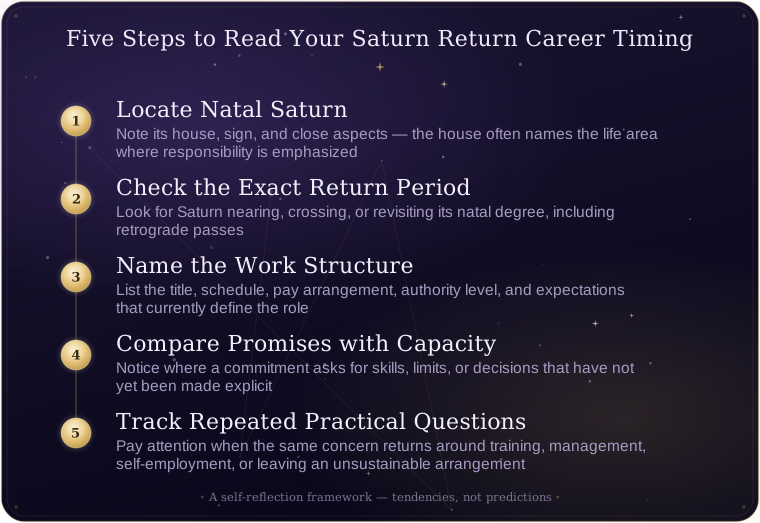
To read Saturn return career change in real life, start with evidence that connects work structure to the part of the chart Saturn occupies. The following observations keep the interpretation specific rather than turning ordinary uncertainty into a cosmic command. The chart does not replace a budget, a contract, or a conversation with a supervisor. It gives symbolic context to questions that can then be checked against deadlines, savings, family needs, and available opportunities. A useful reading also distinguishes a temporary workplace conflict from a pattern that has repeated across different roles.
- Locate natal Saturn. Note its house, sign, and close aspects; the house often names the life area where standards and responsibility are emphasized.
- Check the exact return period. Look for Saturn nearing, crossing, or revisiting its natal degree, including retrograde passes rather than one dramatic date.
- Name the work structure. List the title, schedule, pay arrangement, authority level, and expectations that currently define the role.
- Compare promises with capacity. Notice where a commitment asks for skills, limits, or decisions that have not yet been made explicit.
- Track repeated practical questions. Pay attention when the same concern returns around training, management, self-employment, or leaving an unsustainable arrangement.
Common Misreadings
Several popular readings flatten a career threshold into a story of sudden reinvention. A more useful reading makes room for choice, timing, and ordinary constraints. The correction is not to make the transit smaller; it is to describe its boundaries more accurately. These distinctions help a reader notice a pattern without handing all practical judgment to a chart. It can mark a review period, not a public turning point, and the outer change may remain modest.
- “A Saturn return means quitting.” A career-focused return can show up as renegotiating duties, seeking a credential, setting a boundary, or committing more fully to work already in progress.
- “Everyone has the same career theme.” The natal house and sign change the emphasis; Saturn near the tenth house is read differently from Saturn in the second, sixth, or eleventh house.
- “The first difficult week proves the interpretation.” A return can unfold through several passes and may overlap with unrelated work events, so a single setback is not enough to define it.
- “Responsibility always means staying put.” Sometimes maturity appears as remaining; sometimes it appears as ending an arrangement that cannot meet clear terms.
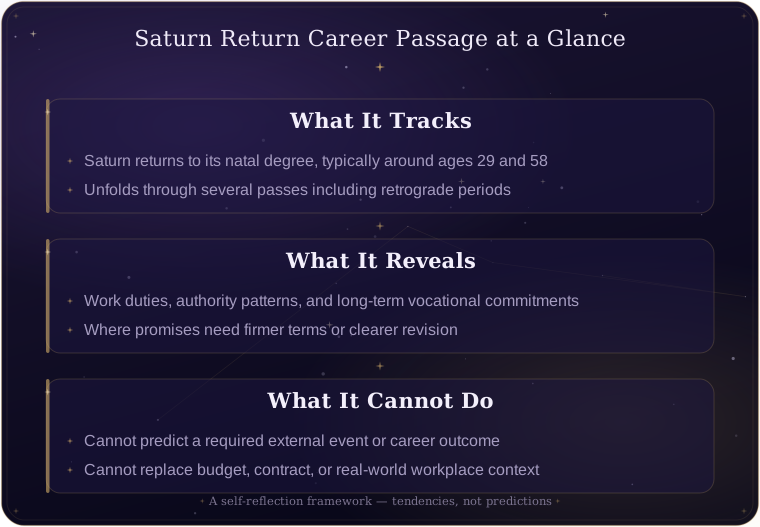
This Career Passage at a Glance
| Property | How It Works | Energy Center | How to Observe |
|---|---|---|---|
| Timing | Saturn returns to its natal degree, sometimes through several passes | Natal Saturn degree and age window | Compare current Saturn degrees with the birth chart |
| Career emphasis | Work themes are filtered through Saturn’s natal house and aspects | Natal house and natal sign | Review duties, authority, and long-term commitments |
| Practical tension | The passage highlights where promises need firmer terms or revision | Existing work structure | Notice recurring questions about scope, pay, training, or leadership |
| Interpretation limit | It describes a symbolic pattern, not a required event | Whole natal chart | Separate chart themes from financial, family, and labor-market facts |
Common Questions About the Career Passage
Does a Saturn return always cause a job change?
No. A job change is one possible expression, but the same period may coincide with a new manager, a clearer contract, added qualifications, or a decision to make an existing role more sustainable.
When does a Saturn return affect career decisions most strongly?
Astrologers usually look at the dates when Saturn approaches and crosses the natal degree, including retrograde returns. The career relevance depends on the natal house, Saturn’s aspects, and whether current choices actually involve work or public responsibility.
Can a Saturn return career change happen before age twenty-nine?
Major work decisions can happen at any age, but the first Saturn return is commonly associated with the late twenties because Saturn takes roughly twenty-nine and a half years to orbit the Sun. According to NASA, Saturn takes about 29.5 years to complete one orbit, which explains why later returns occur near the late fifties.
What if I do not want to make a career decision during my return?
That reluctance is useful information, not a failure to follow the transit. A person can use the period to clarify terms, save money, ask for support, or wait until a choice is workable.
Reflection Prompts
- Think of a recent work decision where clearer limits would have changed the outcome.
- Recall a role you stayed in for security; what responsibility did it genuinely support?
- During Saturn return career change, which commitment feels chosen rather than inherited?
Related Reading
explanation of trine aspects — Helpful for comparing supportive planetary contacts with Saturn’s demand for clear terms.
north node meaning — Useful when considering how a career decision relates to a longer sense of direction.
rising sign meaning — Adds context about the chart angle often used when considering public presentation and vocational direction.
Astrological transit (Wikipedia)
This is not a clinical interpretation or mental health advice.
Take Action
Start with the Explore Your Saturn Return calculator and enter accurate birth details. The calculator can also help you note whether the return is approaching, exact, or revisiting the natal degree.
It identifies the timing of the return and gives you a focused starting point for locating natal Saturn in your chart.
Use that timing to distinguish a passing work frustration from a larger question about the commitments you want your career to hold. Bring one concrete work question to the result, such as whether a promise needs clearer terms or whether a new responsibility matches your available capacity.
Sources
- Robert Hand — a major modern voice in transit interpretation and the practice of reading current planetary contacts through the natal chart.